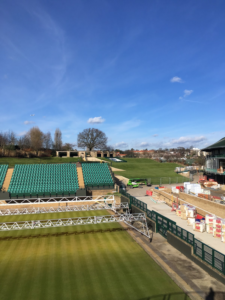
View from the top of the media center. The longest tennis match in history occurred in the court pictured. Behind it is the famous hill spectators sit on.
Today We traveled to Wimbledon to experience the magic of one of the best tennis grand slams in the world. With the help of our friendly tour guide, we got to learn about the history of Wimbledon, see the grounds and imagine what Church Road looks like every two weeks at the beginning of July.
Wimbledon has grown based on the idea of tradition. During the first part of our visit, we learned about Wimbledon’s history, how traditions have evolved and how Wimbledon is trying to grow their brand.
Wimbledon’s full name is The All England Lawn Tennis and Croquet Club which was founded in 1868. The Wimbledon Championship started in 1877, but only consisted of Men’s singles competition. Ladies’ singles and gentlemen’s doubles were added in 1884 and ladies’ doubles and mixed doubles events started in 1913. As the popularity of tennis grew, Wimbledon started to gain more attention. Traditions evolved such as wearing an all-white outfit, spectators enjoying strawberries and cream with a glass of champagne, and sitting on the hill to watch world class tennis matches.
Women’s Singles Championship plate
Our tour guide, Patrick, showed us around the grounds of Wimbledon. We started by going to the Wimbledon Learning Centre, traditionally used by the ball boys and girls during the Wimbledon tournament.
Men’s Singles Championship cup!
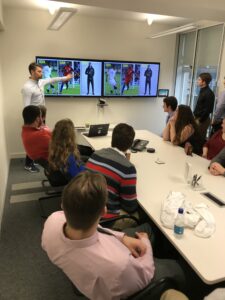
There, we learned a little bit about the history of Wimbledon, how Wimbledon operates as a business, and the global image that Wimbledon has developed. We then went and toured the Wimbledon media center. While in the media center, Patrick brought us into the Sky Sports Deutschland studio as well as the BBC sport studio. While in the Sky Sports studio we were able to look out over court 18 where the longest game of tennis was played during the Wimbledon tournament in 2010 between John Isner and Nicolas Mahut.
From there we toured around the rest of the grounds including Center Court and ended in the Wimbledon Museum looking at both the men’s and women’s singles trophies. The day left us all dreaming about becoming professional tennis players and competing at Wimbledon.
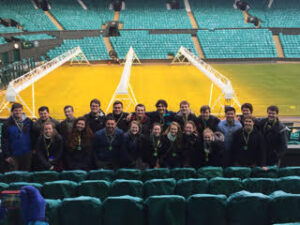
Group shot at Center Court. The best tennis players in the world have played here!
We visited Kingsmeadow, home of Chelsea women’s soccer, in Kingston.
Right outside the Chelsea Ladies’ stadium. The Chelsea Ladies match had a totally different atmosphere than a men’s EPL match.
In a crowd of around 1100 fans, we celebrated a 1-0 Chelsea win against Everton. Currently in second place, this win helped Chelsea continue to have success in the league. We witnessed Crystal Dunn, a member of the US women’s national team, play 90 minutes for Chelsea. We sat in the second row as we cheered on The Blues in a close match. We interviewed Anna Huber, a member of Carleton Women’s soccer, to hear her thoughts on the game.
How would you describe the stadium and atmosphere?
Anna: The stadium was small with a capacity of only around 4,000 fans. This created a very intimate experience. When there are less people there, you feel more important as a fan. The atmosphere was relatively relaxed.
With a ticket, you could sit wherever you could find a seat. We were able to sit in the second row at half field and really enjoy the game. There were a lot of families in the crowd.
What was the most exciting moment of the match?
Anna: The most exciting moment was when Chelsea scored in the 84rd minute. The buildup to the goal was very pretty, with about five passes across the top of the box. Jonna Andersson
was very composed and scored in the upper left corner of the goal. We were all very happy to see a goal and cheered very loud.
It was a perfect day to watch football. The Chelsea Ladies ended with a 1-0 win.
How did this game differ from the Tottenham vs. Everton game we experienced?
Anna: Wembley stadium is much bigger than Kingsmeadow, and Wembley creates a more intense, pressured environment. The men’s game is clearly more popular than the women’s game, and I anticipate this will always be true. We saw Tottenham play under lights at night, while the Chelsea women’s game was during the day. Regarding the actual play, the women and men’s game differs the most in the speed of play. The women’s game is a much slower game but not in a bad way.
Did any of the players stand out to you?
Anna: It was great to see Crystal Dunn play in person. I am a huge fan of the US Women’s National Team, so it is always an incredible experience to watch any of the players live. Although she was super fast, Dunn did not have the best game, but I’m sure it was just a slight off day.
I was most impressed by Katie Chapman, a center midfielder for Chelsea. She was very composed and great at keeping the ball under pressure. She was a very tall presence for Chelsea and changed the game by distributing the ball out wide. She started the play that scored the goal and ended up winning the game for Chelsea.
Did anything surprise you about the match?
Anna: Everton missed a penalty kick in the first half. The player shot the ball off the right post. If Everton had made the penalty kick, I think the whole game would have changed, and the outcome definitely could have been different. It is reassuring to know that even the best players miss penalty kicks sometimes too.
Are there differences between the women’s league and play in England and the United States?
Anna: Growing up watching the US women’s national team has been incredible. I am inspired by the great role models on the national team who are the best players in the world. I will always believe that the US women’s national team is the best in the world, and I think this is because they are more fit and faster than the English players.
This Saturday we were privileged to both play and watch a match at the Twickenham Stoop. Although we didn’t get to play on the actually pitch, we had a lovely clinic from two great coaches on a practice pitch nearby. The two hour clinic could be divided into five main parts. First, we warmed up by running about two different squares in two separate groups. Intermittently, the coaches would call out a direction, and we would drop to the ground, squat, jump in the air, or even switch squares. In addition, we passed several small balls around within our group. After that, we scrimmaged against each other playing two touch rugby. We slowly began to grasp the rules, macro-strategy, and dynamic of the game, and the coaches sought to accelerate that process by breaking us back off into groups. In those groups, we would play a three on one offensive scenario.
View from our seats of the game. The game never had a dull moment!
This drill emphasized the importance of spacing, managing possession, and defensive commitment. We then scrimmaged again, and the quality was much improved from before both in terms of flow and speed of play. Finally, we got to teach the coaches a thing or two. They asked to play American football with us, and we obliged. Spirits remained high throughout the entire clinic despite the pitch being muddy, the weather being overcast, and the wind being swift and cold. These coaches were perhaps the best we have had so far. They allowed us to improve on our own, yet guided us towards that better state of play. Not only that, but they were personable throughout, as demonstrated especially by their willingness to play American football with us.
The rugby game itself was fun and whimsical, and continued our theme of home, favored teams winning. The Quins blew out the Scarlets 35-7 in a one-sided affair, bring their record to 3-0 in Premiership Rugby. The Quins dominated defensively, barely allowing the Scarlets out of their third of the field, but also won out in terms of toughness and physicality by bruising their way for a try on more than one occasion. Overall, this trip to Twickenham was both educational and fun, as we got the full rugby experience by both playing and watching at as high a level as we could manage.
Today we traveled to Nike’s UK Headquarters to learn about Nike’s role in UK sports. We met with Ralph Newbrook who plays a part in Nike’s relationship with the Premier League. We specifically works with the Tottenham Hotspurs and Manchester City.
Ralph Newbrook was a very passionate speaker. He left us wanting to work for the Nike brand, whether it be as an athlete or on corporate.
He aims to get the most out of the rights Nike has earned through contracts with these football teams in order to promote the brand and eventually, generate more business.
He does this by regulating things such as player appearances, photo shoots, and kit reveals using celebrities. He showed us a video in which AJ Tracey, a famous Grime artist (somewhat like rap music), performed at a concert and revealed the new Tottenham Hotspurs jersey halfway through to promote the team to all his fans. Another example was Paul Rodriguez, a skateboarder, who did a photoshoot in the new stadium to drum up interest. Ralph is in charge of deciding when, where, and how Nike uses these rights to create the most amount of business.
Ralph also described to us how Nike targets athletes and partners with them in order to help raise the athlete to the world stage and bring the Nike brand along with them.
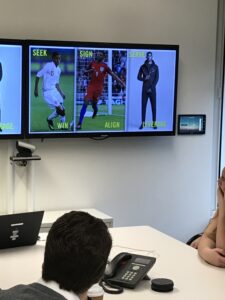
Marcus Rashford used to explain how Nike finds athletes to represent the Nike brand.
He used Marcus Rashford, a professional footballer playing for Manchester United and the English National Team, as an example of an athlete who they signed at a young age and brought the Nike brand to the international stage. Ralph also showed us how successful Nike has been at locking down star athletes, specifically in the English Premier League. He presented us statistics on the number of overall goals scored weekly in the league by all footballers, and over 60% of them were Nike sponsored athletes.
At the end of the very polished and engaging session, he asked for questions. We discussed how scandals have affected the brand, how rights transfer after managers have been sacked, and the possibility of football growing in the United States among other things. At the end of the discussion, Ralph gave our students the task of giving him one idea of how Nike can help tap into the largely untapped US market for football (or what we call soccer).
On January 17th, we went to visit Opta Sport. Opta Sport, founded in 1996, was created to analyze data
Entrance to Opta
about Premier League football. Today they have expanded their work to analyzing 30 sports across 70 different countries, and have over 800 teams and clients that use Opta’s analytics.
When we first walked into the Opta’s building, we were in a lobby that was very interesting to look around. The first thing I noticed was a television that was running a program about an in depth analysis for the upcoming World Cup this summer, which talked about every team’s odds to win the tournament, along with the chances that teams make it to certain round of the World Cup. On the right hand wall of the lobby, there were 3 larger than life pictures of American football player Odell Beckham, tennis player Serena Williams, and basketball player Steph Curry. On the left hand wall were 3 more athletes: football (soccer) player Cristiano Ronaldo, golfer Jason Day, and a cricketer we were unable to identify. There were also interesting pictures on doors and the wall of the lobby too, such as one of Arrowhead Stadium and one of FC Bayern players.
The first part of our Opta Sport experience was going into a room that were filled with television screens
Ruby tests out Opta’s Data Collection software
and people typing away in front of their computers. We talked to two employees who were showing us how they keep stats for football games. They were using the first leg of the Chelsea vs Arsenal Carabao Cup game as an example for us to follow and it was crazy to even try to keep up with what they were doing. They were following where the ball went, via dribbling, passing and shooting, while simultaneously tracking each time a ball was touched by a player. This meant they were constantly clicking their mouse to register a ball touch, while dragging where the ball was going on their screen that represented a soccer field, and somehow changing the number of the player who had the ball all at the same time. They gave us the opportunity to try to replicate their jobs, and it took a while to register a single movement of the ball, which takes about 1 second of real time. It just showed how impressive it was that they could move that fast to track a whole game in real time.
The second phase of our visit was a presentation given by Edwin White and Tom Reynolds. The
Edwin White presenting about what Opta does for sports teams around the world.
presentation provided us with information on everything Opta, including who they work with. Some of the largest names in broadcasting, sports betting, online sports coverage, and the best leagues and clubs in the world use Opta for their statistical analysis. Some of these include: ESPN, DirecTV, Fox Sports, NBC, Sky Bet, CNN, Yahoo and many, many more. The EPL, Bundesliga, and most of the major football leagues around the world also use Opta for its statistics along with some of the best individual clubs in the world such as FC Barcelona, Manchester City, and Bayern Munich. Individual clubs often use the statistics to aid in the scouting of players. Any EPL match watched in the United States uses Opta stats and graphics that are gathered and presented live from Opta.
Tom Reynolds presenting about the mechanics of Opta and how teams use Opta’s research
Opta’s statistics and analysis are so sought after that teams pay upwards of 20,000 pounds for the player data that they gather to help the clubs with their scouting and analysis. It was really interesting when they started showing us how Opta can be used. They showed us how their data can be used for scouting. There seemed to be about a thousand possible filters to search for. In our example, we were looking for a holding midfielder, under 24 years old, who has played over 10 games and has above an 80% pass completion and the program was able to give a list of about 15 players in the Premier League. They also showed us how players from the previous season performed compared to their expectations (expectations were calculated by a very complicated algorithm). A third way that the program proved helpful was looking at every pass made my Leicester City over the past few games and we could see where they liked to play the ball the most. There were many other potential uses for their programs which seem to be very useful so it’s no surprise that 19 out of the 20 Premier League teams look to Opta for their data.
Team shot after the presentation. Everyone is now saving up to buy Opta’s Data Collection to improve their own sports game!
On Saturday we went to a Premiere League soccer match between the Tottenham Hotspurs and Everton. It was a high scoring match which finished in a 4-0 win for Tottenham. The match was played at Wembley stadium which is Tottenham’s home field this season, as they build a new £750 million stadium.
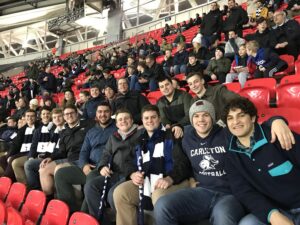
Students waiting for the match to begin. Also pictured is London School of Economics professor Dr. Shadlen who taught a class during the 2014 program.
We got to the match by taking the tube which dropped us off just a few minutes’ walk from the entrance to the stadium. The street was packed as we walked into the stadium full of boisterous fans. Some of the group decided to go to a local pub to immerse themselves in the complete fan experience. At the pub, they witnessed loyal lifelong fans take part in pre-match traditions such as watching highlights from earlier games, and singing Tottenham songs. They saw people ranging from small children, maybe five or six years old, all the way to grandparents in their mid-80’s. It was clear that no matter the age, Tottenham soccer was a way of life for these fans.
Once in the stadium most of the crowd appeared to be cheering for the home team and the home team supporter section was extremely rowdy and they filled the stadium with loud chants. However, we were sitting in an upper corner of the stadium and the crowd was much calmer than we had expected. The group found it extremely interesting that even 20 minutes before the game the stadium was empty, which is unlike most sporting events in the US. However, in the five minutes before the game started the stadium immediately became packed.
Picture taken before fans began to fill the seatsPicture taken once the match started. The stadium was filled with roaring fans
Samantha Kile said “my favorite part was how excited everyone was, and I really liked the chants. I couldn’t always tell what they were saying but most of the crowd seemed to know the chants well. It made them seem very united.” Not only did we enjoy the atmosphere itself, but the soccer was even more impressive to see live than it is when watching on television. Annika Martensson said that her favorite part of going was that she “really enjoyed getting to see so many goals!” What surprised so many of the people in our group was how little pageantry there was before the start of the game and the second half. Unlike US sporting events, once it was time to start, the referees blew the whistle and the game started. There were no huge announcements before the game except for the reading of the lineups, or half time activities like there are in the NBA or NFL, which caused a few of the people in the group who were getting snacks to miss an early goal in the second half.
The game started off with a goal by Everton that was called back because of an offsides penalty. As somewhat neutral supporters we could clearly feel the dramatic shift in emotion as the Everton fans had an early go-ahead goal taken away from them, and Tottenham quickly responded by scoring their own goal. From then on Tottenham was clearly the dominant team on the field. Each time Tottenham scored a goal, all of Wembley Stadium erupted in cheer and song as if it had been a game winning goal. After four goals, and an impressive victory the Tottenham fans continued their excitement as they left the stadium and filled the streets with Tottenham songs. The consensus throughout the entire group was that there could not have been any better way that we could have started off our trip. This was an amazing first Premier League game for many of us in the group.
It would be inadvisable to visit London and not travel to one of its twelve league football clubs. It would be normal to visit one of the big four clubs in London. It would be extraordinary to receive a talk from a distinguished writer as well as historian on football, eat traditional food in an even more traditional working class cafe, and visit Arsenal’s historic Highbury Stadium and tour their current home the Emirates all in the course of a day. And yet, on Monday all twenty-two of our group found ourselves doing just that.
We began with an engaging lecture on the history of professional football in London from Simon Inglis, a distinguished writer in that particular field. Simon’s insights, however, come from a variety of jobs and hobbies relating to football, from photography to being interviewed, from lecturing to researching. In his talk, Simon sought not just to give us background on the football tradition in London, but also to provide us with a high level perspective on what heritage means for football in London. Because we were visiting Arsenal later that day, we looked at English football’s legacy through the lens of Arsenal’s distinguished, decorated, and unique place in the city’s professional footballing history.
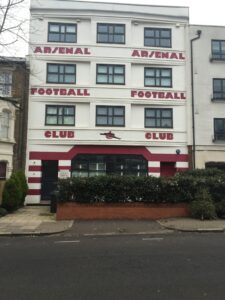
The old Arsenal stadium is still intact. It is now a residential area.
Next, we set off for Highbury Stadium, and traveled by Tube a few miles North. Along the way we got a glimpse at Simon’s remarkable bank of knowledge and insight. We discussed such topics as Leicester City’s remarkable Premier League win, the reason for the every rising cost of football players, and more. When we arrived at Highbury Stadium, Simon regaled us with the essential facts and his personal memories of Highbury. Highbury, Arsenal’s old stadium from 1913 to 2006, was one of the finest stadiums in England. Therefore, it was a shock when Arsenal decided to move from Highbury about a mile to Emirates Stadium. Highbury, instead of being torn down completely, was to be transformed into an apartment complex, with the pitch turned into a lovely garden, and the stands remodeled into apartments.
We then walked a short distance to a little British cafe that featured classics such as fish, chips, and peas, bacon, beans, bubble and squeak, and more. Simon was kind enough to take our orders while a ketchup bottle exploded everywhere. The wall, posters, and three of our compatriots were doused in ketchup, much to the amusement of all the rest of us. After the owner assured us we were ok, and we enjoyed our meal, we then left for Emirates Stadium.
At Park Cafe where supporters gather for a meal before an Arsenal match.
As we arrived at Emirates, we witnessed many of the notable Arsenal players over the years, such as Dennis Bergkamp and Thierry Henry. Next, we saw a remarkable visual of all Arsenal players who played at Highbury. Finally, we went inside and got our audio devices for guiding us around and providing context to what we’d be seeing.
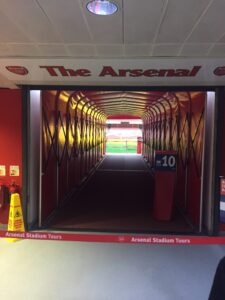
First, we went through the initial halls of the stadium, where there were the women’s team’s trophies, as well as busts of their most famous managers, from Herbert Chapman to Arsene Wenger. Next, we took a look at the pitch from the upper balcony, and explored the Diamond Club, where the most distinguished and famous guests could view games. After that, we finally got to go down to the pitch and walk through the tunnel to look at it from a mere ten feet away.
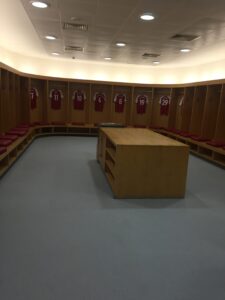
We then went into the visiting and home locker rooms, which were both kitted out with hot baths, cold baths, showers, and a posh dressing room.
Arsenal tunnel where players and referees enter the pitch.Arsenal locker room. Regeneration pool and athletic training facility was located inside.
Lastly, we went through both the small interview rooms and the larger press conference room. It was a great day and we were so lucky to have Simon along on this adventure with us. What a great way to start off our journey in London!
Simon Inglis showing students past players of the Arsenal football team.